What Name Did the Japanese Use to Refer to the Art of Woodblock Printing in Humanities
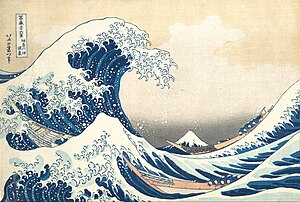
Woodblock printing in Japan ( 木版画 , mokuhanga ) is a technique all-time known for its employ in the ukiyo-e artistic genre of single sheets, but it was also used for press books in the same menstruation. Widely adopted in Japan during the Edo menses (1603–1868) and similar to woodcut in Western printmaking in some regards, the mokuhanga technique differs in that it uses water-based inks—as opposed to western woodcut, which typically uses oil-based inks. The Japanese water-based inks provide a broad range of vivid colors, glazes, and transparency.
History [edit]
In 764 the Empress Kōken commissioned one million pocket-sized wooden pagodas, each containing a modest woodblock gyre printed with a Buddhist text (Hyakumantō Darani). These were distributed to temples around the country equally thank you for the suppression of the Emi Rebellion of 764. These are the earliest examples of woodblock printing known, or documented, from Nippon.[ane]
By the eleventh century, Buddhist temples in Japan produced printed books of sutras, mandalas, and other Buddhist texts and images. For centuries, printing was mainly restricted to the Buddhist sphere, as information technology was too expensive for mass production, and did not have a receptive, literate public as a market place. However, an of import set of fans of the late Heian period (twelfth century), containing painted images and Buddhist sutras, reveal from loss of paint that the underdrawing for the paintings was printed from blocks.[2] In the Kamakura period from the 12th century to the 13th century, many books were printed and published by woodblock printing at Buddhist temples in Kyoto and Kamakura.[1]
Western manner movable type printing-press was brought to Japan by Tenshō embassy in 1590, and was first printed in Kazusa, Nagasaki in 1591. However, western printing-printing were discontinued after the ban on Christianity in 1614.[1] [3] The press-press seized from Korea past Toyotomi Hideyoshi'due south forces in 1593 was also in use at the same time equally the press press from Europe. An edition of the Confucian Analects was printed in 1598, using a Korean moveable type printing press, at the order of Emperor Go-Yōzei.[1] [4]
Tokugawa Ieyasu established a press school at Enko-ji in Kyoto and started publishing books using domestic wooden movable type printing-press instead of metal from 1599. Ieyasu supervised the product of 100,000 types, which were used to impress many political and historical books. In 1605, books using domestic copper movable type printing-press began to be published, but copper blazon did non go mainstream after Ieyasu died in 1616.[1]
The great pioneers in applying movable type press printing to the cosmos of artistic books, and in preceding mass product for general consumption, were Honami Kōetsu and Suminokura Soan. At their studio in Saga, Kyoto, the pair created a number of woodblock versions of the Japanese classics, both text and images, substantially converting emaki (handscrolls) to printed books, and reproducing them for wider consumption. These books, at present known every bit Kōetsu Books, Suminokura Books, or Saga Books, are considered the outset and finest printed reproductions of many of these archetype tales; the Saga Book of the Tales of Ise (Ise monogatari), printed in 1608, is particularly renowned.[5]
Despite the appeal of moveable type, however, craftsmen soon decided that the running script style of Japanese writings was improve reproduced using woodblocks. By 1640 woodblocks were once over again used for nearly all purposes.[6] Later on the 1640s, movable blazon printing declined, and books were mass-produced by conventional woodblock press during most of the Edo period.[1] [7]
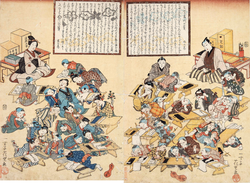
A 2 piece nishiki-e (colored woodblock print) series depicting a class at terakoya (individual educational school).
The mass production of woodblock prints in the Edo menstruum was due to the loftier literacy charge per unit of Japanese people in those days. The literacy charge per unit of the Japanese in the Edo flow was almost 100% for the samurai form and 50% to 60% for the chōnin and nōmin (farmer) class due to the spread of private schools terakoya. In that location were more than than 600 rental bookstores in Edo, and people lent woodblock-printed illustrated books of diverse genres. While the Saga Books were printed on expensive paper, and used various embellishments, being printed specifically for a small circumvolve of literary connoisseurs, other printers in Edo apace adapted the conventional woodblock press to producing cheaper books in large numbers, for more general consumption. The content of these books varied widely, including travel guides, gardening books, cookbooks, kibyōshi (satirical novels), sharebon (books on urban culture), kokkeibon (comical books), ninjōbon (romance novel), yomihon, kusazōshi, art books, play scripts for the kabuki and jōruri (puppet) theatre, etc. The best-selling books of this catamenia were Kōshoku Ichidai Otoko (Life of an Amorous Human being) by Ihara Saikaku, Nansō Satomi Hakkenden by Takizawa Bakin, and Tōkaidōchū Hizakurige by Jippensha Ikku, and these books were reprinted many times.[ane] [8] [9] [10] [11]
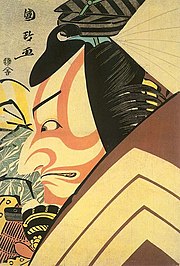
From the 17th century to the 19th century, ukiyo-eastward depicting secular subjects became very popular among the common people and were mass-produced. ukiyo-e is based on kabuki actors, sumo wrestlers, beautiful women, landscapes of sightseeing spots, historical tales, and and so on, and Hokusai and Hiroshige are the about famous artists. In the 18th century, Suzuki Harunobu established the technique of multicolor woodblock printing called nishiki-e and greatly developed Japanese woodblock printing culture such as ukiyo-e. Ukiyo-eastward influenced European Japonisme and Impressionism.[one] [8] Yoshitoshi was called the last cracking ukiyo-e main, and his cruel depictions and fantastic expressions influenced after Japanese literature and anime.[12] [13] The price of one ukiyo-east at that time was near 20 mon, and the price of a basin of soba noodles was 16 mon, so the cost of 1 ukiyo-east was several hundred yen to g yen in today's currency.[xiv]
Many publishing houses arose and grew, publishing both books and single-sheet prints. One of the virtually famous and successful was Tsuta-ya. A publisher'south ownership of the concrete woodblocks used to print a given text or image constituted the closest equivalent to a concept of "copyright" that existed at this fourth dimension. Publishers or individuals could purchase woodblocks from ane another, and thus take over the production of sure texts, but beyond the ownership of a given set of blocks (and thus a very particular representation of a given subject), there was no legal conception of the ownership of ideas. Plays were adopted by competing theaters, and either reproduced wholesale, or individual plot elements or characters might be adapted; this activity was considered legitimate and routine at the time.[15]
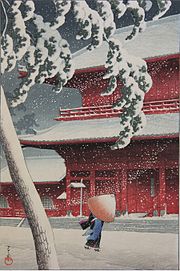
After the decline of ukiyo-due east and introduction of modern printing technologies, woodblock press continued equally a method for printing texts equally well as for producing fine art, both within traditional modes such every bit ukiyo-east and in a variety of more than radical or Western forms that might be construed every bit modern art. In the early 20th century, shin-hanga that fused the tradition of ukiyo-e with the techniques of Western paintings became popular, and the works of Hasui Kawase and Hiroshi Yoshida gained international popularity.[16] [17] Institutes such as the "Adachi Institute of Woodblock Prints" and "Takezasado" go on to produce ukiyo-due east prints with the same materials and methods as used in the past.[18] [19]
Technique [edit]
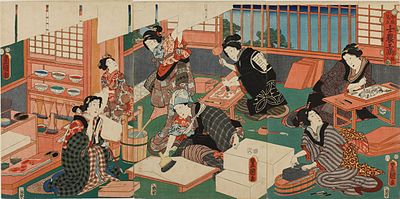
The woodblock printing process, Kunisada, 1857. A fantasy version, wholly staffed by well-dressed "beauties". In fact few women worked in printmaking.
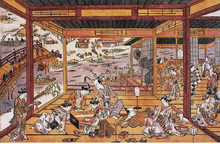
The technique for printing texts and images was more often than not like. The obvious differences were the volume produced when working with texts (many pages for a single work), and the complexity of multiple colors in some images. Images in books were almost always in monochrome (black ink only), and for a fourth dimension art prints were likewise monochrome or done in merely two or three colors.
The text or image is first fatigued onto thin washi (Japanese paper), called gampi, then glued face-downwardly onto a plank of close-grained wood, usually a cake of shine cherry. Oil could exist used to brand the lines of the image more than visible. An incision is made along both sides of each line or expanse. Forest is and so chiseled away, based on the cartoon outlines. The block is inked using a brush then a flat hand-held tool called a baren is used to press the paper against the woodblock to apply the ink to the paper. The traditional baren is made in three parts, it consists of an inner core made from bamboo leaves twisted into a rope of varying thicknesses, the nodules thus created are what ultimately applies the pressure to the print. This coil is contained in a disk called an "ategawa" made from layers of very thin paper which is glued together and wrapped in a dampened bamboo foliage, the ends of which are and so tied to create a handle. Modern printmakers have adapted this tool, and today barens are made of aluminum with brawl bearings to apply the force per unit area are used; too equally less expensive plastic versions.
The beginning prints were just one-color (sumizuri-e), with additional colors applied past hand (kappazuri-due east). The evolution of two registration marks carved into the blocks chosen "kento" was especially helpful with the introduction of multiple colors that had to be applied with precision over previous ink layers. The canvass of newspaper to be printed is placed in the kento, so lowered onto the woodblock.
While, again, text was nearly always monochrome, every bit were images in books, the growth of the popularity of ukiyo-e brought with it demand for ever increasing numbers of colors and complication of techniques. The stages of this development follow:
- Sumizuri-e ( 墨摺り絵 , "ink printed pictures")—monochrome printing using but black ink
- Beni-east ( 紅絵 )—monochrome prints unremarkably printed in pink[20]
- Benizuri-east ( 紅摺り絵 , "crimson printed pictures")—ruddy ink details or highlights added by hand after the printing process; green was sometimes used as well
- Tan-e ( 丹絵 )—orangish highlights using a red pigment called tan
- Aizuri-east ( 藍摺り絵 , "indigo printed pictures"), Murasaki-e ( 紫絵 , "purple pictures"), and other styles in which a single color was used in addition to, or instead of, black ink
- Urushi-due east ( 漆絵 )—a method that thickened the ink with glue, emboldening the image. Printers often used gold, mica, and other substances to enhance the image further. Urushi-east can as well refer to paintings using lacquer instead of paint. Lacquer was rarely, if ever, used on prints.
- Nishiki-due east ( 錦絵 , "brocade pictures")—a method of using multiple blocks for separate portions of the image, using a number of colors to reach circuitous and detailed images. A separate block was carved to apply just the part of the image designated for a single color. Registration marks called kentō ( 見当 ) were used to ensure correspondence between the awarding of each cake.
Schools and movements [edit]

Japanese printmaking, as with many other features of Japanese art, tended to organize itself into schools and movements. The most notable schools (see also schools of ukiyo-e artists) and, afterwards, movements of moku-hanga were:
- Torii school, from 1700
- Kaigetsudō school, from 1700–14
- Katsukawa school, from about 1720s, including the artists Shunsho and Shuntei[21]
- Kawamata school, from about 1725, including the artists Suzuki Harunobu and Koryusai[21]
- Hokusai school, from about 1786, including the artists Hokusai, Hokuei and Gakutei[21]
- Kitagawa school, from about 1794, including the artists Utamaro I, Kikumaro I and II[21]
- Utagawa school, from 1842, including the artists Kunisada and Hiroshige[21]
- Sōsaku-hanga, "Creative Prints" movement, from 1904
- Shin-hanga "New Prints" movement, from 1915, including Hasui Kawase and Hiroshi Yoshida[22]
Other artists, such equally Sharaku, Kabukidō Enkyō, Sugakudo, and Shibata Zesshin, are considered contained artists, gratis of school associations, and presumably, without the resulting associated benefits from publishers, who might be less inclined to produce prints by an unaffiliated artist. However, many of the surviving examples speak to the contrary. The earliest examples by these artists are among the most desirable, valuable, and rarest of all ukiyo-e. Additionally, many examples exhibit very fine printing, using expensive mica (kirazuri), premium inks and the highest quality papers.[21]
Print sizes [edit]
Following are common Tokugawa-flow print sizes. Sizes varied depending on the catamenia, and those given are guess; they are based on the pre-printing paper sizes, and newspaper was often trimmed later on printing.[23]
| name | trans. | cm (in) | ref |
|---|---|---|---|
| koban ( 小判 ) | small most ane⁄iv the size of ōban | 19.five × thirteen (7.7 × 5.ane) | |
| aiban ( 合判 ) | intermediate | 34 × 22.v (13.4 × viii.9) | [23] |
| bai-ōban ( 倍大判 ) | intermediate | 45.7 × 34.5 (18.0 × 13.6) | [24] |
| chūban ( 中判 ) | medium | 26 × 19 (x.two × seven.v) | [23] |
| hashira-e ( 柱絵 ) | pillar print | 73 × 12 (28.seven × 4.vii) | [23] |
| hosoban ( 細判 ) or hoso-e ( 細絵 ) [24] | narrow | 33 × xiv.5 (13.0 × 5.7) | [23] |
| 39 × 17 (15.four × half dozen.seven) | [23] | ||
| kakemono-e ( 掛物絵 ) | hanging scroll | 76.5 × 23 (xxx.1 × 9.i) | [23] |
| nagaban ( 長判 ) | long | l × xx (19.7 × 7.9) | [23] |
| ōban ( 大判 ) | large | 38 × 25.5 (15.0 × x.0) | [23] |
| 58 × 32 (23 × 13) | [23] | ||
| ō-tanzaku ( 大短冊判 ) | large verse form card | 38 × 17 (xv.0 × six.7) | [23] |
| chū-tanzaku ( 中短冊判 ) | medium poem card | 38 × 13 (15.0 × v.i) | [23] |
| surimono ( 刷物 ) | 35 × 20 (xiii.8 × 7.9) | [23] | |
| 12 × 9 (4.7 × 3.5) – 19 × 13 (vii.v × 5.i) | [23] |
The Japanese terms for vertical (portrait) and horizontal (landscape) formats for images are tate-due east (立て絵) and yoko-eastward (横絵), respectively.
See also [edit]
- Listing of ukiyo-e terms
- List of art techniques
Notes [edit]
- ^ a b c d due east f g h The Past, Present and Future of Printing in Nihon. Izumi Munemura. (2010). The Surface Finishing Lodge of Japan.
- ^ Paine, 136
- ^ Lane, Richard (1978). Images of the Floating Earth. Old Saybrook, CT: Konecky & Konecky. p. 33. ISBN1-56852-481-1.
- ^ Ikegami, Eiko (2005-02-28). Bonds of Civility: Aesthetic Networks and the Political Origins of Japanese Culture. Cambridge University Press. ISBN9780521601153.
- ^ Kotobank Saga Books. The Asahi Shimbun.
- ^ Sansom, George (1961). A History of Japan: 1334–1615 . Stanford, California: Stanford University Press.
- ^ History of printing. The Japan Federation of Printing Industries.
- ^ a b Edo Picture Books and the Edo Flow. National Nutrition Library.
- ^ 第6回 和本の楽しみ方4 江戸の草紙. Konosuke Hashiguchi. (2013) Seikei Academy.
- ^ Nihonbashi. Mitsui Fdosan.
- ^ Keizaburo Seimaru. (2017) 江戸のベストセラー. Yosensha. ISBN 978-4800312556
- ^ Yoshitoshi: The Fantabulous Decadent/the Concluding Master of Ukiyo-E . Shinichi Segi.
- ^ One Hundred Aspects of the Moon, Tsukioka Yoshitoshi. The Nagoya Japanese Sword Museum "Nagoya Touken Earth"
- ^ 浮世絵の購入・売却 (in Japanese). Nagoya Japanese Sword Museum Nagoya Touken World. Archived from the original on February 23, 2022. Retrieved Feb 23, 2022.
- ^ 北斎・広重-浮世絵木版画出版から探る- 江戸時代における知的財産戦略. Satoshi Kobayashi. (2007) Hitotsubashi University.
- ^ Shin hanga bringing ukiyo-e back to life. The Japan Times.
- ^ Junko Nishiyama. (2018) 新版画作品集 ―なつかしい風景への旅. p18. Tokyo Bijutsu. ISBN 978-4808711016
- ^ "浮世絵・木版画のアダチ版画研究所".
- ^ "木版印刷・伝統木版画工房 竹笹堂".
- ^ "JAANUS / beni-due east 紅絵". www.aisf.or.jp . Retrieved 25 November 2021.
- ^ a b c d e f The Prints of Japan, Frank A. Turk, October Firm Inc ,1966, Lib Congress catalog Card no. 66-25524
- ^ Fresh Impressions, Kendall Brownish, Publisher: University of Washington Press, September 2013, ISBN 0935172513
- ^ a b c d eastward f chiliad h i j g l m n Faulkner & Robinson 1999, p. twoscore.
- ^ a b Harris 2011, p. 31.
References [edit]
- Faulkner, Rupert; Robinson, Basil William (1999). Masterpieces of Japanese Prints: Ukiyo-east from the Victoria and Albert Museum. Kodansha International. ISBN978-four-7700-2387-2.
- Forrer, Matthi, Willem R. van Gulik, Jack Hillier A Sheaf of Japanese Papers, The Hague, Social club for Japanese Arts and crafts, 1979. ISBN 90-70265-71-0
- Harris, Frederick (2011). Ukiyo-east: The Art of the Japanese Impress. Tuttle Publishing. ISBN978-4-8053-1098-four.
- Kaempfer, H. M. (ed.), Ukiyo-e Studies and Pleasures, A Drove of Essays on the Art of Japanese Prints, The Hague, Gild for Japanese Craft, 1978. ISBN 90-70216-01-9
- Nussbaum, Louis Frédéric and Käthe Roth. (2005). Japan Encyclopedia. Cambridge: Harvard Academy Press. ISBN 978-0-674-01753-5; OCLC 48943301
- Friese, Gordon (2007). "Hori-shi. 249 facsimiles of different seals from 96 Japanese engravers." Unna, Nordrhein-Westfalen: Verlag im bücherzentrun.
- Lane, Richard. (1978). Images from the Floating World, The Japanese Print. Oxford: Oxford University Press. ISBN 9780192114471; OCLC 5246796
- Paine, Robert Care for, in: Paine, R. T. & Soper A, "The Art and Compages of Nippon", Pelican History of Art, 3rd ed 1981, Penguin (now Yale History of Art), ISBN 0140561080.
- Sansom, George (1961). "A History of Japan: 1334–1615." Stanford, California: Stanford University Press.
- Rikardson, Anders (1978). "Japanese Woodblock Prints" Malmö: Antik & Auktion.
Further reading [edit]
- Whitmore, Paul 1000.; Cass, Glen R. (February 1988). "The Ozone Fading of Traditional Japanese Colorants". Studies in Conservation. Maney Publishing on behalf of the International Institute for Conservation of Historic and Artistic Works. 33 (1): 29–twoscore. doi:10.1179/sic.1988.33.i.29. JSTOR 1506238.
External links [edit]
- Encyclopedia of Woodblock Printmaking by David Bull
- Creating a Woodblock Print From Kickoff to Finish Video (42 mins)
- Ukiyo-eastward.org Japanese Woodblock print search engine
Source: https://en.wikipedia.org/wiki/Woodblock_printing_in_Japan
0 Response to "What Name Did the Japanese Use to Refer to the Art of Woodblock Printing in Humanities"
Enregistrer un commentaire