St Catharine of Siena Church Reading Pa
| Saint Catherine of Siena T.O.S.D | |
|---|---|
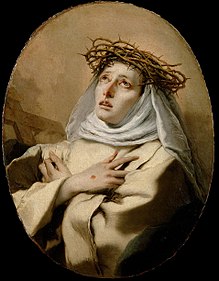 St. Catherine of Siena, | |
| Virgin, Patron of Europe (Patrona Europae), Stigmatist, Doctor of the Church building | |
| Born | 25 March 1347 Siena, Republic of Siena |
| Died | 29 April 1380 (aged 33) Rome, Papal States |
| Venerated in | Catholic Church Anglican Communion[1] Lutheranism[2] |
| Canonized | 29 June 1461 past Pope Pius II |
| Major shrine | Santa Maria sopra Minerva, Rome and Shrine of Saint Catherine, Siena |
| Feast | 29 April; 30 April (Roman Calendar, 1628–1969); 4 Oct (in Italy) |
| Attributes | Dominican tertiaries' habit, lily, book, crucifix, cupid, heart, crown of thorns, stigmata, ring, dove, rose, skull, miniature church building, miniature ship bearing Papal coat of arms |
| Patronage | confronting burn; bodily ills; Diocese of Allentown, Pennsylvania, USA; Europe; illness; Italy; Bambang, Nueva Vizcaya, Philippines; Samal, Bataan, Philippines; miscarriages; people ridiculed for their piety; sexual temptation; sick people; sickness; nurses |
Catherine of Siena (25 March 1347 – 29 Apr 1380), a lay fellow member of the Dominican Guild, was a mystic, activist, and author who had a corking influence on Italian literature and on the Catholic Church. Canonized in 1461, she is as well a Md of the Church building.
Born and raised in Siena, she wanted from an early on age to devote herself to God, against the will of her parents. She joined the "mantellate", a group of pious women, primarily widows, informally devoted to Dominican spirituality.[3] Her influence with Pope Gregory XI played a office in his 1376 decision to leave Avignon for Rome. The Pope then sent Catherine to negotiate peace with Florence. After Gregory Xi's death (March 1378) and the determination of peace (July 1378), she returned to Siena. She dictated to secretaries her set of spiritual treatises The Dialogue of Divine Providence. The Great Schism of the Due west led Catherine of Siena to go to Rome with the pope. She sent numerous letters to princes and cardinals to promote obedience to Pope Urban VI and to defend what she calls the "vessel of the Church". She died on 29 April 1380, exhausted by her rigorous fasting. Urban VI celebrated her funeral and burial in the Basilica of Santa Maria sopra Minerva in Rome.
Devotion around Catherine of Siena developed apace afterwards her death. Pope Pius II canonized her in 1461; she was declared a patron saint of Rome in 1866 by Pope Pius IX, and of Italy (together with Francis of Assisi) in 1939 by Pope Pius XII.[4] [5] [half-dozen] [7] [8] She was the second woman to exist declared a "doctor of the Church building," on four October 1970 by Pope Paul VI - simply days after Teresa of Ávila. In 1999 Pope John Paul 2 proclaimed her a [co-]patron saint of Europe.
Catherine of Siena is one of the outstanding figures of medieval Catholicism, past the strong influence she has had in the history of the papacy and her extensive authorship.[ citation needed ] She was backside the return of the Pope from Avignon to Rome, and and then carried out many missions entrusted to her past the pope, something quite rare for a woman in the Middle Ages. Her Dialogue, hundreds of letters, and dozens of prayers, too give her a prominent identify in the history of Italian literature.
Life [edit]
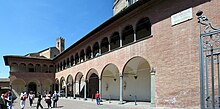
The house of Saint Catherine in Siena
Caterina di Jacopo di Benincasa was born on 25 March 1347 (shortly before the Black Death ravaged Europe) in Siena, Republic of Siena (today Italia), to Lapa Piagenti, the daughter of a local poet, and Jacopo di Benincasa, a cloth dyer who ran his enterprise with the help of his sons.[ix] The business firm where Catherine grew upwards still exists. Lapa was nigh forty years erstwhile when she gave premature birth to twin daughters Catherine and Giovanna. She had already borne 22 children, but half of them had died. Giovanna was handed over to a wet-nurse and died before long after. Catherine was nursed by her female parent and developed into a healthy kid. She was two years old when Lapa had her 25th child, another daughter named Giovanna.[10] As a kid Catherine was so merry that the family unit gave her the pet name of "Euphrosyne", which is Greek for "joy" and the name of an Euphrosyne of Alexandria.[11]
Catherine is said past her confessor and biographer Raymond of Capua O.P.'south Life to have had her commencement vision of Christ when she was five or half-dozen years sometime: she and a brother were on the way home from visiting a married sister when she is said to have experienced a vision of Christ seated in celebrity with the Apostles Peter, Paul, and John. Raymond continues that at age seven, Catherine vowed to give her whole life to God.[11] [12]
When Catherine was sixteen, her older sister Bonaventura died in childbirth; already anguished past this, Catherine before long learned that her parents wanted her to marry Bonaventura's widower. She was absolutely opposed and started a strict fast. She had learned this from Bonaventura, whose husband had been far from considerate only his wife had inverse his attitude by refusing to consume until he showed meliorate manners. Besides fasting, Catherine further disappointed her mother past cut off her long hair as a protest confronting being overly encouraged to improve her advent to attract a husband.[13]
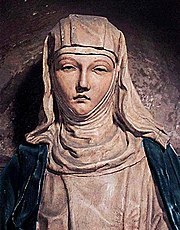
Catherine would after advise Raymond of Capua to do during times of trouble what she did now as a teenager: "Build a prison cell inside your mind, from which you can never flee." In this inner cell she fabricated her male parent into a representation of Christ, her female parent into the Blessed Virgin Mary, and her brothers into the apostles. Serving them humbly became an opportunity for spiritual growth. Catherine resisted the accustomed form of marriage and motherhood on the one paw, or a nun's veil on the other. She chose to alive an active and prayerful life outside a convent'south walls following the model of the Dominicans.[xiv] Eventually her male parent gave up and permitted her to live as she pleased.[ citation needed ]
A vision of Saint Dominic gave strength to Catherine, but her wish to join his Club was no comfort to Lapa, who took her girl with her to the baths in Bagno Vignoni to better her health. Catherine savage seriously sick with a violent rash, fever and pain, which conveniently made her female parent accept her wish to join the "Mantellate", the local clan of devout laywomen.[15] The Mantellate taught Catherine how to read, and she lived in almost total silence and solitude in the family dwelling.[15]
Her custom of giving abroad wearable and nutrient without asking anyone's permission cost her family significantly, but she requested nix for herself. By staying in their midst, she could alive out her rejection of them more strongly. She did not desire their nutrient, referring to the table laid for her in Heaven with her real family.[16]

According to Raymond of Capua, at the historic period of twenty-one (c. 1368), Catherine experienced what she described in her letters as a "Mystical Spousal relationship" with Jesus,[17] subsequently a popular field of study in art as the Mystic wedlock of Saint Catherine. Caroline Walker Bynum explains one surprising and controversial aspect of this matrimony that occurs both in artistic representations of the event and in some early accounts of her life: "Underlining the extent to which the marriage was a fusion with Christ's physicality [...] Catherine received, not the ring of gold and jewels that her biographer reports in his bowdlerized version, but the ring of Christ's foreskin."[18] [xix] Catherine herself mentions the foreskin-as-wedding ceremony band motif in one of her messages (#221), equating the wedding band of a virgin with a foreskin; she typically claimed that her own wedding ceremony ring to Christ was just invisible.[xx] She wrote in a letter (to encourage a nun who seems to accept been undergoing a prolonged flow of spiritual trial and torment): "Bathe in the claret of Christ crucified. See that you don't look for or want anything but the crucified, as a true bride ransomed past the blood of Christ crucified – for that is my wish. Yous run across very well that you are a bride and that he has espoused you – you and everyone else – and non with a ring of silver but with a ring of his own flesh. Look at the tender little child who on the eighth twenty-four hours, when he was circumcised, gave up merely then much flesh as to make a tiny circlet of a band!"[21] Raymond of Capua too records that she was told past Christ to go out her withdrawn life and enter the public life of the world.[22] Catherine rejoined her family and began helping the sick and the poor, where she took intendance of them in hospitals or homes. Her early on pious activities in Siena attracted a group of followers, women and men, who gathered around her.[9]
As social and political tensions mounted in Siena, Catherine found herself fatigued to arbitrate in wider politics. She made her kickoff journey to Florence in 1374, probably to be interviewed past the Dominican regime at the General Chapter held in Florence in May 1374, though this is disputed (if she was interviewed, then the absence of afterwards bear witness suggests she was accounted sufficiently orthodox).[13] It seems that at this fourth dimension she acquired Raymond of Capua as her confessor and spiritual director.[23]
After this visit, she began travelling with her followers throughout northern and central Italy advocating reform of the clergy and advising people that repentance and renewal could exist done through "the total love for God."[24] In Pisa, in 1375, she used what influence she had to sway that city and Lucca abroad from alliance with the anti-papal league whose force was gaining momentum and strength. She also lent her enthusiasm towards promoting the launch of a new crusade. It was in Pisa in 1375 that, according to Raymond of Capua's biography, she received the stigmata (visible, at Catherine's request, only to herself).[23]
Physical travel was not the only way in which Catherine fabricated her views known. From 1375[23] onwards, she began dictating letters to scribes.[15] These letters were intended to reach men and women of her circle, increasingly widening her audience to include figures in say-so every bit she begged for peace between the republics and principalities of Italia and for the return of the Papacy from Avignon to Rome. She carried on a long correspondence with Pope Gregory Xi, request him to reform the clergy and the assistants of the Papal States.[ citation needed ]
Towards the end of 1375, she returned to Siena, to assist a young political prisoner, Niccolò di Tuldo, at his execution.[23] [25] In June 1376 Catherine went to Avignon as administrator of the Republic of Florence to brand peace with the Papal States (on 31 March 1376 Gregory Eleven had placed Florence nether interdict). She was unsuccessful and was disowned by the Florentine leaders, who sent ambassadors to negotiate on their own terms equally soon as Catherine'south work had paved the way for them.[23] Catherine sent an appropriately scorching letter back to Florence in response.[26] While in Avignon, Catherine also tried to convince Pope Gregory XI, the last Avignon Pope, to render to Rome.[27] Gregory did indeed render his administration to Rome in Jan 1377; to what extent this was due to Catherine's influence is a topic of much modernistic debate.[28]
Catherine returned to Siena and spent the early on months of 1377 founding a women'south monastery of strict observance outside the city in the old fortress of Belcaro.[29] She spent the residuum of 1377 at Rocca d'Orcia, almost twenty miles from Siena, on a local mission of peace-making and preaching. During this catamenia, in autumn 1377, she had the experience which led to the writing of her Dialogue and learned to write, although she all the same seems to have chiefly relied upon her secretaries for her correspondence.[9] [thirty]
Belatedly in 1377 or early in 1378 Catherine again travelled to Florence, at the social club of Gregory XI, to seek peace between Florence and Rome. Following Gregory's death in March 1378 riots, the revolts of the Ciompi, broke out in Florence on eighteen June, and in the ensuing violence she was near assassinated. Eventually, in July 1378, peace was agreed between Florence and Rome; Catherine returned quietly to Florence.[ citation needed ]
In late November 1378, with the outbreak of the Western Schism, the new Pope, Urban VI, summoned her to Rome. She stayed at Pope Urban Half dozen's court and tried to convince nobles and cardinals of his legitimacy, both meeting with individuals at courtroom and writing messages to persuade others.[29]
For many years she had accustomed herself to a rigorous abstinence.[31] She received the Holy Eucharist almost daily. This extreme fasting appeared unhealthy in the eyes of the clergy and her own sisterhood. Her confessor, Raymond, ordered her to swallow properly. But Catherine claimed that she was unable to, describing her inability to swallow as an infermità (illness). From the beginning of 1380, Catherine could neither eat nor eat water. On 26 February she lost the utilise of her legs.[29]
Catherine died in Rome, on 29 April 1380, at the age of thirty-iii,[32] having viii days earlier suffered a massive stroke which paralyzed her from the waist downwards. Her last words were, "Father, into Your Hands I commend my soul and my spirit."[33]
Sources of her life [edit]
There is some internal evidence of Catherine's personality, instruction and work in her nigh four hundred letters, her Dialogue, and her prayers.[ citation needed ]
Much detail about her life has also, nonetheless, been drawn from the various sources written shortly after her decease in order to promote her cult and canonization. Though much of this material is heavily hagiographic, it has been an important source for historians seeking to reconstruct Catherine's life. Various sources are specially important, peculiarly the works of Raymond of Capua, who was Catherine'due south spiritual manager and close friend from 1374 until her death, and himself became Master General of the Social club in 1380. Raymond wrote what is known equally the Legenda Major, his Life of Catherine which was completed in 1395, 15 years after Catherine'southward death.[34]
Some other of import work written after Catherine'due south expiry was Libellus de Supplemento (Little Supplement Volume), written betwixt 1412 and 1418 by Tommaso d'Antonio Nacci da Siena (commonly chosen Thomas of Siena, or Tommaso Caffarini); the work is an expansion of Raymond'south Legenda Major making heavy use of the notes of Catherine's showtime confessor, Tommaso della Fonte (notes that exercise non survive anywhere else). Caffarini later published a more than compact business relationship of Catherine'southward life, entitled the Legenda Pocket-size.[ citation needed ]
From 1411 onwards, Caffarini also coordinated the compiling of the Processus of Venice, the set of documents submitted every bit part of the procedure of canonisation of Catherine, which provides testimony from near all of Catherine's disciples. In that location is besides an bearding piece entitled "Miracoli della Beata Caterina" (Miracle of Blessed Catherine), written by an anonymous Florentine. A few other relevant pieces survive.[35]
Works [edit]
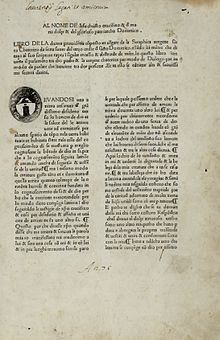
Libro della divina dottrina (commonly known as The Dialogue of Divine Providence), c.1475
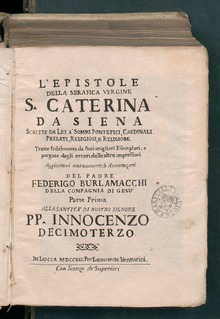
L'epistole della serafica vergine due south. Caterina da Siena (1721)
3 genres of work by Catherine survive:
- Her major treatise is The Dialogue of Divine Providence. This had probably begun in October 1377 and was certainly finished by Nov 1378. Contemporaries of Catherine are united in asserting that much of the volume was dictated while Catherine was in ecstasy, though it also seems possible that Catherine herself may and so have re-edited many passages in the volume.[36] Information technology is a dialogue between a soul who "rises up" to God and God himself.[ citation needed ]
- Catherine's letters are considered one of the keen works of early Tuscan literature. Many of these were dictated, although she herself learned to write in 1377; 382 have survived. In her letters to the Pope, she often addressed him affectionately just as Babbo ("Daddy"), instead of the formal form of address "Your Holiness".[37] Other correspondents include her various confessors, amid them Raymond of Capua, the kings of French republic and Hungary, the infamous mercenary John Hawkwood, the Queen of Naples, members of the Visconti family of Milan, and numerous religious figures.[38] Approximately i third of her messages are to women.[ citation needed ]
- Xx-six prayers of Catherine of Siena too survive, mostly equanimous in the final eighteen months of her life.
The University of Alcalá conserves a unique handwritten Spanish manuscript, while other available texts are printed copies collected by the National Library of France.[39]
Theology [edit]
Catherine'due south theology tin be described as mystical, and was employed towards practical ends for her own spiritual life or those of others.[40] She used the language of medieval scholastic philosophy to elaborate her experiential mysticism.[41] Interested mainly with achieving an incorporeal spousal relationship with God, Catherine expert extreme fasting and divineness, eventually to the extent of living solely off the Eucharist every twenty-four hours.[42] For Catherine, this practice was the means to fully realize her love of Christ in her mystical experience, with a large proportion of her ecstatic visions relating to the consumption or rejection of food during her life.[43] She viewed Christ as a "bridge" between the soul and God and transmitted that idea, forth with her other teachings, in her book The Dialogue.[44] The Dialogue is highly systematic and explanatory in its presentation of her mystical ideas; notwithstanding, these ideas themselves are not and so much based on reason or logic as they are based in her ecstatic mystical feel.[45]
In one of her messages she sent to her confessor, Raymund of Capua, she recorded this revelation from her conversation with Christ, in which he said: "Do you know what you are to Me, and what I am to you, my girl? I am He who is, you are she who is not".[46] This mystical concept of God as the wellspring of being is seen in the works and ideas of Aquinas[47] and can be seen every bit a simplistic rendering of embodiment and a more rudimentary form of the doctrine of divine simplicity.[48] She describes God in her work, 'the Dialogues', as a "ocean, in which we are the fish", the indicate being that the relationship between God and man should not be seen as man contending against the Divine and vice versa, but as God being the endless being that supports all things.[49]
Veneration [edit]

She was buried in the (Roman) cemetery of Santa Maria sopra Minerva which lies near the Pantheon. Subsequently miracles were reported to take place at her grave, Raymond moved her inside the Basilica of Santa Maria sopra Minerva, where she lies to this day.[50]

The Chapel of Saint Catherine, Basilica of San Domenico in Siena
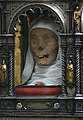
Her head all the same, was parted from her body and inserted in a gilt bosom of bronze. This bust was later taken to Siena, and carried through that urban center in a procession to the Dominican church. Behind the bust walked Lapa, Catherine's mother, who lived until she was 89 years old. By then she had seen the end of the wealth and the happiness of her family, and followed about of her children and several of her grandchildren to the grave. She helped Raymond of Capua write his biography of her daughter, and said, "I recollect God has laid my soul athwart in my body, so that it can't go out."[51] The incorrupt head and thumb were entombed in the Basilica of San Domenico at Siena, where they remain.[52] [53] [54]
Pope Pius 2, himself from Siena, canonized Catherine on 29 June 1461.[55]
On 4 October 1970, Pope Paul VI named Catherine a Dr. of the Church;[6] this title was almost simultaneously given to Teresa of Ávila (27 September 1970),[56] making them the first women to receive this honour.[55]
Initially however, her feast twenty-four hour period was not included in the General Roman Calendar. When it was added in 1597, it was put on the day of her death, 29 April; however, considering this conflicted with the feast of Saint Peter of Verona which as well fell on 29 April, Catherine's feast twenty-four hours was moved in 1628 to the new appointment of xxx April.[57] In the 1969 revision of the agenda, information technology was decided to leave the commemoration of the feast of St Peter of Verona to local calendars, because he was not too known worldwide, and Catherine'south feast was restored to 29 April.[58]
Catherine is remembered in the Church building of England with a Lesser Festival on 29 April.[59]
Patronage [edit]
In his decree of thirteen April 1866, Pope Pius IX declared Catherine of Siena to exist a co-patroness of Rome. On 18 June 1939 Pope Pius XII named her a articulation patron saint of Italy along with Saint Francis of Assisi.[v]
On ane Oct 1999, Pope John Paul Two made her 1 of Europe'due south patron saints, along with Saint Teresa Benedicta of the Cross and Saint Bridget of Sweden.[7] [eight] She is as well the patroness of the historically Catholic American woman'southward fraternity, Theta Phi Alpha.[60]
Severed caput [edit]
The people of Siena wished to have Catherine's torso. A story is told of a miracle whereby they were partially successful: knowing that they could not smuggle her whole trunk out of Rome, they decided to take only her head which they placed in a bag. When stopped past the Roman guards, they prayed to Catherine to assist them, confident that she would rather have her body (or at to the lowest degree part thereof) in Siena. When they opened the bag to show the guards, it appeared no longer to hold her head but to be full of rose petals.[61]
Legacy [edit]
Catherine ranks high amid the mystics and spiritual writers of the Church.[13] She remains a greatly respected effigy for her spiritual writings, and political boldness to "speak truth to power"—it existence exceptional for a woman, in her time menstruum, to have had such influence in politics and on world history.[ citation needed ]
Main sanctuaries [edit]
The chief churches in honor of Catherine of Siena are:
- Santa Maria sopra Minerva in Rome: identify where her body is preserved.[62]
- Basilica of San Domenico in Siena: in this church building the incorrupt head of Catherine of Siena is preserved.[61]
- Shrine of Saint Catherine in Siena: circuitous of religious buildings built effectually the birthplace of Catherine.[63]
Images [edit]
-
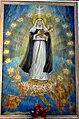
Michele de Meo, Catherine of Siena, Patroness of Europe, 2003, Chapel of St. James, Church of Santa Maria sopra Minerva
-

Domenico Beccafumi, The Miraculous Communion of St. Catherine of Siena, c. 1513–1515, Getty Center, Los Angeles, California
-

Domenico Beccafumi, St. Catherine of Siena Receiving the Stigmata, c. 1513–1515, Getty Heart, Los Angeles, California
-
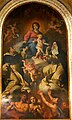
The Virgin Mary Giving the Rosary to St. Dominic and St. Catherine of Siena, Church of Santa Agata in Trastevere, Rome (Lesser of painting: the souls in Purgatory await the prayers of the faithful)
-

-
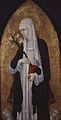
Giovanni di Paolo, St. Catherine of Siena, c. 1475, tempera and aureate on panel. Fogg Fine art Museum, Cambridge, England.
-

The role of the taxcollector (biccherna) of Siena by an unknown artist, 1451 - 1452, Rijksmuseum Amsterdam
-
Works [edit]
Mod editions and English translations
- The Italian critical edition of the Dialogue is Catherine of Siena, Il Dialogo della divina Provvidenza: ovvero Libro della divina dottrina, 2nd ed., ed. Giuliana Cavallini (Siena: Cantagalli, 1995). [1st edn, 1968] [Cavallini demonstrated that the standard division of the Dialogue in into four treatises entitled the 'Treatise on Discretion', 'On Prayer', 'On Providence', and 'On Obedience', was in fact a result of a misreading of the text in the 1579 edition of the Dialogue. Modern editors and translators, including Noffke (1980), have followed Cavallini in rejecting this fourfold division.]
- The Italian critical edition of the 26 Prayers is Catherine of Siena, Le Orazioni, ed. Giuliana Cavallini (Rome: Cateriniane, 1978)
- The nigh recent Italian critical edition of the Letters is Antonio Volpato, ed, Le lettere di Santa Caterina da Siena: l'edizione di Eugenio Duprè Theseider e i nuovi problemi, (2002)
English language translations of The Dialogue include:
- The Dialogue, trans. Suzanne Noffke, O.P. Paulist Press (Classics of Western Spirituality), 1980.
- The Dialogue of St. Catherine of Siena, TAN Books , 2009. ISBN 978-0-89555-149-eight
- Phyllis Hodgson and Gabriel M Liegey, eds., The Orcherd of Syon, (London; New York: Oxford UP, 1966) [A Center English translation of the Dialogo from the early fifteenth century, offset printed in 1519].
The Messages are translated into English equally:
- Catherine of Siena (1988). Suzanne Noffke (ed.). The Letters of St. Catherine of Siena. Vol. 4. Binghamton: Center for Medieval and Early on Renaissance Studies, State Academy of New York at Binghamton. ISBN978-0-86698-036-4. (Republished as The messages of Catherine of Siena, 4 vols, trans Suzanne Noffke, (Tempe, AZ: Arizona Centre for Medieval and Renaissance Studies, 2000–2008))
The Prayers are translated into English every bit:
- The Prayers of Catherine of Siena, trans. Suzanne Noffke, 2nd edn 1983, (New York, 2001)
Raymond of Capua's Life was translated into English in 1493 and 1609, and in Modern English is translated equally:
- Raymond of Capua (1980). Conleth Kearns (ed.). The Life of Catherine of Siena. Wilmington: Glazier. ISBN978-0-89453-151-four.
See also [edit]
- Feast of Saint Catherine
- Biblioteca Comunale degli Intronati
- Mystical marriage of Saint Catherine
- Order of Preachers
- Saints and levitation
- Saint Catherine of Siena, patron saint archive
- Churches defended to Catherine of Siena
- War of the Viii Saints
References [edit]
- ^ "Holy Men and Holy Women" (PDF). Churchofengland.org.
- ^ "Notable Lutheran Saints". Resurrectionpeople.org. Archived from the original on 16 May 2019. Retrieved 16 July 2019.
- ^ Longo, F. Thomas (2006). "Cloistering Catherine: Religious Identity in Raymond of Capua'south Legenda Maior of Catherine of Siena". Studies in Medieval and Renaissance History. 3: 25–69.
- ^ Haegen, Anne Mueller von der; Strasser, Ruth F. (2013). "St. Catherine of Siena: Mystic, Politician, and Saint". Art & Architecture: Tuscany. Potsdam: H.F.Ullmann Publishing. p. 334. ISBN978-3-8480-0321-1.
- ^ a b (in Italian) Pope Pius XII, Pontifical Cursory, eighteen June 1939.
- ^ a b (in Italian) Declaration to Doctor of the Church building, Homily, iv October 1970.
- ^ a b Proclamation of the Co-Patronesses of Europe, Apostolic Letter, one October 1999. Archived 20 November 2022 at the Wayback Auto
- ^ a b Liturgical Feast of St. Bridget, Homily, 13 November 1999.
- ^ a b c Edmund Garratt Gardner (1908). "St. Catherine of Siena". Cosmic Encyclopedia. three. New York: Robert Appleton Company. Archived from the original on 29 November 2009. Retrieved 5 Apr 2021.
- ^ Skårderud 2008, p. 411.
- ^ a b Lives of Saints, John J. Crawley & Co., Inc.
- ^ Raymond of Capua, Legenda Major I, iii.
- ^ a b c Foley O.F.M., Leonard. Saint of the Day, Lives, Lessons, and Banquet, (revised past Pat McCloskey O.F.Grand.), Franciscan Media, ISBN 978-0-86716-887-seven
- ^ "CR Meyer Manpower Planner". manpower.webfittersstaging.com. Archived from the original on 13 January 2021. Retrieved ane Dec 2020.
- ^ a b c Catherine of Siena. Available Means. Ed. Joy Ritchie and Kate Ronald. Pittsburgh, Pa.: University of Pittsburgh Press, 2001. Print.
- ^ Skårderud 2008, pp. 412–413.
- ^ Raymond of Capua 2003, pp. 99–101.
- ^ Bynum, Caroline Walker (1987). Holy Feast and Holy Fast. The Religious Significance of Nutrient to Medieval Women. University of California Printing. p. 246. ISBN978-0-520-06329-7.
- ^ Manseau, Peter (2009). Rag and Bone. A Journeying Among the World's Holy Expressionless. London: Macmillan. ISBN978-142993-665-ane.
Some [nuns], almost famously Saint Catherine of Siena, imagined wearing the foreskin as a wedding band.
- ^ Jacobs, Andrew (2012). Christ Circumcised: A Study in Early Christian History and Departure. University of Pennsylvania Press. p. 192. ISBN978-0812206517 . Retrieved 22 October 2015.
- ^ The Letters of Saint Catherine of Siena, Volume II, Suzanne Noffke OP, Arizona Center for Medieval and Renaissance Studies Tempe Arizona 2001, p. 184
- ^ Raymond of Capua 2003, pp. 105–107.
- ^ a b c d e Noffke, p. 5. sfn error: no target: CITEREFNoffke,_p._5 (help)
- ^ Hollister & Bennett 2002, p. 342.
- ^ Letter T273, written by Catherine to Raymond, probably in June 1375, describes the event.
- ^ Letter 234 in Tommaseo's numbering.
- ^ Hollister & Bennett 2002, p. 343.
- ^ Run across Bernard McGinn, The Varieties of Vernacular Mysticism, (Herder & Herder, 2012), p. 561.
- ^ a b c Noffke, p. vi. sfn error: no target: CITEREFNoffke,_p._6 (aid)
- ^ This experience is recorded in Alphabetic character 272, written to Raymond in October 1377.
- ^ "Butler, Alban. The Lives or the Fathers, Martyrs and Other Principal Saints, Vol. Four, D. & J. Sadlier, & Company, (1864)".
- ^ Farmer, David Hugh (1997). The Oxford dictionary of saints (4. ed.). Oxford [u.a.]: Oxford Univ. Printing. p. 93. ISBN978-0-19-280058-9.
- ^ Caffarini, Tommaso (1974). Libellus de supplemento: legende prolixe virginis beate Catherine de Senis.
- ^
- ^ Noffke, p. 2. sfn error: no target: CITEREFNoffke,_p._2 (help)
- ^ Noffke, p. 13. sfn mistake: no target: CITEREFNoffke,_p._13 (help)
- ^ Egan, Jennifer (1999). "Ability Suffering". The New York Times Magazine . Retrieved xv April 2019.
- ^ Forbes, Cheryl (2004). "The Radical Rhetoric of Caterina Da Siena". Rhetoric Review. Taylor & Francis, Ltd. 23 (two): 121–140. doi:10.1207/s15327981rr2302_2. JSTOR 20176608. S2CID 143039500.
- ^ Lyons, Martin (1 December 2013). Celestial messages: morals and magic in nineteenth-century France. French History. Vol. 27. pp. 496–514. doi:ten.1093/fh/crt047. ISSN 0269-1191. OCLC 5187349553. At section Six.
- ^ Noffke, Suzanne. "Catherine of Siena." In Medieval Holy Women in the Christian Tradition c. 1100–c. 1500. Alastair J. Minnis and Rosalynn Voaden, eds. Turnhout: Brepols, 2010. 613.
- ^ Foster, Kenelm. "St Catherine'southward Didactics on Christ." Life of the Spirit (1946–1964) 16, no. 187 (1962): 313. JSTOR 43705923.
- ^ Finnegan, Mary Jeremy. "Catherine of Siena: The Two Hungers." Mystics Quarterly 17, no. 4 (1991): 173–80. JSTOR 20717082.
- ^ Noffke, Suzanne. "Catherine of Siena." In Medieval Holy Women in the Christian Tradition c. 1100–c. 1500. Alastair J. Minnis and Rosalynn Voaden, eds. Turnhout: Brepols, 2010.
- ^ Catherine of Siena. The Dialogue. Translated by Suzanne Noffke. The Classics of Western Spirituality. Paulist Press, 1980.
- ^ Noffke, Suzanne. "Catherine of Siena." In Medieval Holy Women in the Christian Tradition c. 1100–c. 1500. Alastair J. Minnis and Rosalynn Voaden, eds. Turnhout: Brepols, 2010. 601–615.
- ^ Benincasa, Catherine (1980). The Dialogues (Translated ed.). Paulist Press. ISBN0809122332. [ folio needed ]
- ^ Aquinas, Tomas (12 Dec 2012). Summa Theologica (Blackfrairs Translation ed.). Emmaus Academic. p. I, q.3. ISBN978-1623400149.
- ^ Barron, Robert; Murray, Paul (2002). Saint Catherine of Siena: Mystic of Fire, Preacher of Freedom. Catholic Publishers. ISBN9780567693181. [ page needed ]
- ^ Benincasa, Catherine; Dutton Scudder, Vida (2019). the Messages of St. Catherine (Transaltion ed.). Proficient Press. ISBN9781406512175. [ page needed ]
- ^ "Santa Maria Sopra Minerva - Rome, Italy". www.sacred-destinations.com . Retrieved 4 October 2021.
- ^ Skårderud 2008, "Jeg tror at Gud har gjort det slik at sjelen ligger på tvers i kroppen min og ikke kan komme ut.".
- ^ Jones, Johnathan (18 Nov 2013). "From St Peter'south basic to severed heads: Christian relics on display". The Guardian . Retrieved 16 September 2021.
- ^ Strochlic, Nina (eleven July 2017). "Siena's Disembodied Saint at the Basilica di San Domenico". The Daily Animal . Retrieved 16 September 2021.
- ^ Standring, Suzette M. (11 October 2018). "Holy relics: The strange exercise of venerating human remains". The Courier-Tribune . Retrieved 16 September 2021.
- ^ a b "St. Catherine of Siena: A Feisty Function for Sister Nancy Murray - April 2006 Result of St. Anthony Messenger Mag Online". 22 April 2006. Archived from the original on 22 Apr 2006. Retrieved 1 December 2020.
- ^ (in Italian) Proclamation of Saint Teresa of Ávila to Medico of the Church, Homily, 27 September 1970.
- ^ "Calendarium Romanum" (Libreria Editrice Vaticana, 1969), p. 91.
- ^ Calendarium Romanum. Libreria Editrice Vaticana. 1969. p. 121.
- ^ "The Agenda". The Church of England . Retrieved 27 March 2021.
- ^ "Data For Parents | Theta Phi Alpha". thetaphialpha.org . Retrieved 5 October 2021.
- ^ a b "St. Catherine of Siena'south Severed Caput". Atlas Obscura . Retrieved 15 April 2019.
- ^ "Tomb of St Catherine of Siena". Santa Maria sopra Minerva . Retrieved fifteen April 2019.
- ^ "Santa Caterina". Viae Siena . Retrieved 15 Apr 2019.
Sources [edit]
- Blessed Raymond of Capua (2003). The Life of St. Catherine of Siena. Translated by Lamb, George. Rockford, Illinois: TAN Books.
- Catherine of Siena (1980). The Dialogue. Translated by Noffke, Suzanne. New York: Paulist Press. ISBN978-0-8091-2233-2.
- Hollister, Warren; Bennett, Judith (2002). Medieval Europe: A Brusk History (9 ed.). Boston: McGraw-Loma Companies Inc. ISBN9780072346572.
- Skårderud, Finn (2008). "Hellig anoreksi Sult og selvskade som religiøse praksiser. Caterina av Siena (1347–80)". Tidsskrift for Norsk Psykologforening (in Norwegian). 45 (4): 408–420. Retrieved 12 May 2013.
Further reading [edit]
- Cross, F. L., ed. (2016). The Oxford Dictionary of the Christian Church. London: Oxford U. P. p. 251. ISBN978-0-192-11655-0.
- Emling, Shelley (2016). Setting the World on Fire: The Brief, Astonishing Life of St. Catherine of Siena. New York: St. Martin'due south Printing. ISBN978-1-137-27980-4.
- Girolamo Gigli, ed., L'opere di Santa Caterina da Siena, 4 vols, (Siena e Lucca, 1707–1721)
- Hollister, Warren; Judith Bennett (2001). Medieval Europe: A Short History (nine ed.). Boston: McGraw-Hill Companies Inc. p. 343. ISBN978-0-07-234657-2.
- Faure, Gabriel (1918). Au pays de sainte Catherine de Sienne. Grenoble: J. Rey. OCLC 9435948.
- McDermott, Thomas, O.P. (2008). Catherine of Siena: spiritual evolution in her life and instruction. New York: Paulist Press. ISBN978-0-8091-4547-eight.
- Carolyn Muessig, George Ferzoco, and Beverly Mayne Kienzle, eds., A Companion to Catherine of Siena, (Leiden: Brill, 2012), ISBN 978-90-04-20555-0 / ISBN 978-90-04-22542-8.
External links [edit]
- Works by Catherine of Siena at Project Gutenberg
- Letters of Catherine from Gutenberg
- Works past or well-nigh Catherine of Siena at Net Annal
- Saint Catherine of Siena: Text with concordances and frequency list
- Drawn past Dearest, The Mysticism of Catherine of Siena
- St. Catherine of Siena at the Christian Iconography web site
- Divae Catharinae Senensis Vita 15th-century manuscript at Stanford Digital Repository
- St Catherine statue – St Peter's Square Colonnade Saints
- "Saint Catherine of Siena: the De Docta Ignorantia ". Invisible Monastery of charity and fraternity – Christian family prayer. Archived from the original on 31 Oct 2018. Retrieved 31 October 2018.
Source: https://en.wikipedia.org/wiki/Catherine_of_Siena
0 Response to "St Catharine of Siena Church Reading Pa"
Enregistrer un commentaire